Paratrechina sp(2) looks fairly similar to their genera cousin Paratrechina longicornis except that they are slightly larger (the minor workers at 4 mm are approx. 30 percent larger) and are polymorphic with a very small number of major workers at 5 mm that are around 25 percent larger than the minor workers. The gasters (when depleted as well as when fully gorged) are also proportionately larger (as a ratio of the rest of the body). The morphological different between the larger and smaller aside from their size difference is in the major the gaster is also proportionately larger. A further difference as observed in this specimen is that they are brownish unlike Paratrechina longicornis which are noticeably black.


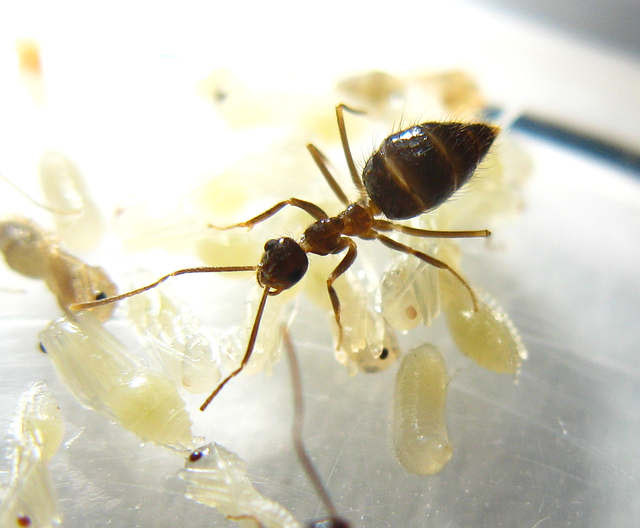


See also other crazy ants:
Taxonomy:
Top Node: cellular organismsSuperkingdom: Eukayota 2759
Opisthokonta 33154
Kingdom: Metazoa 33208 (aka Animalia)
(No Rank): Eumetazoa 6072
(No Rank): Bilateria 33213
(No Rank): Protostomia 33317
(No Rank): Ecdysozoa 1206784
(No Rank):Panarthropoda 88770
Phylum: Arthropoda 6656
(No Rank): Mandibulata 197563
(No Rank): Pancrustacea 197562
Superclass: Hexapoda 6960
Class: Insecta 50557
(No Rank): Dicondylia 85512
(No Rank): Petrygota 7496
Subclass: Neoptera33340
Infraclass: Endopterygota 33392
Order: Hymenoptera 7399
(No Rank): Apocrita 7400
Suborder: Aculeata 7434
Superfamily: Vespoidea 34725
Family: Formicidae 36668
Subfamily: Formicinae 7479
Tribe; Lasiini 72772
Genus: Paratrechina 58224
Last Updated: 2016 11 29
First Posted: 2013 04 04
© 2011 – 2016 Quah. All rights reserved.